Overview
For the wider city plan, keep the Chengdu city hub open while you choose food areas. Travelers who want a broader menu map should also read the China regional food guide and the food allergy guide for China.
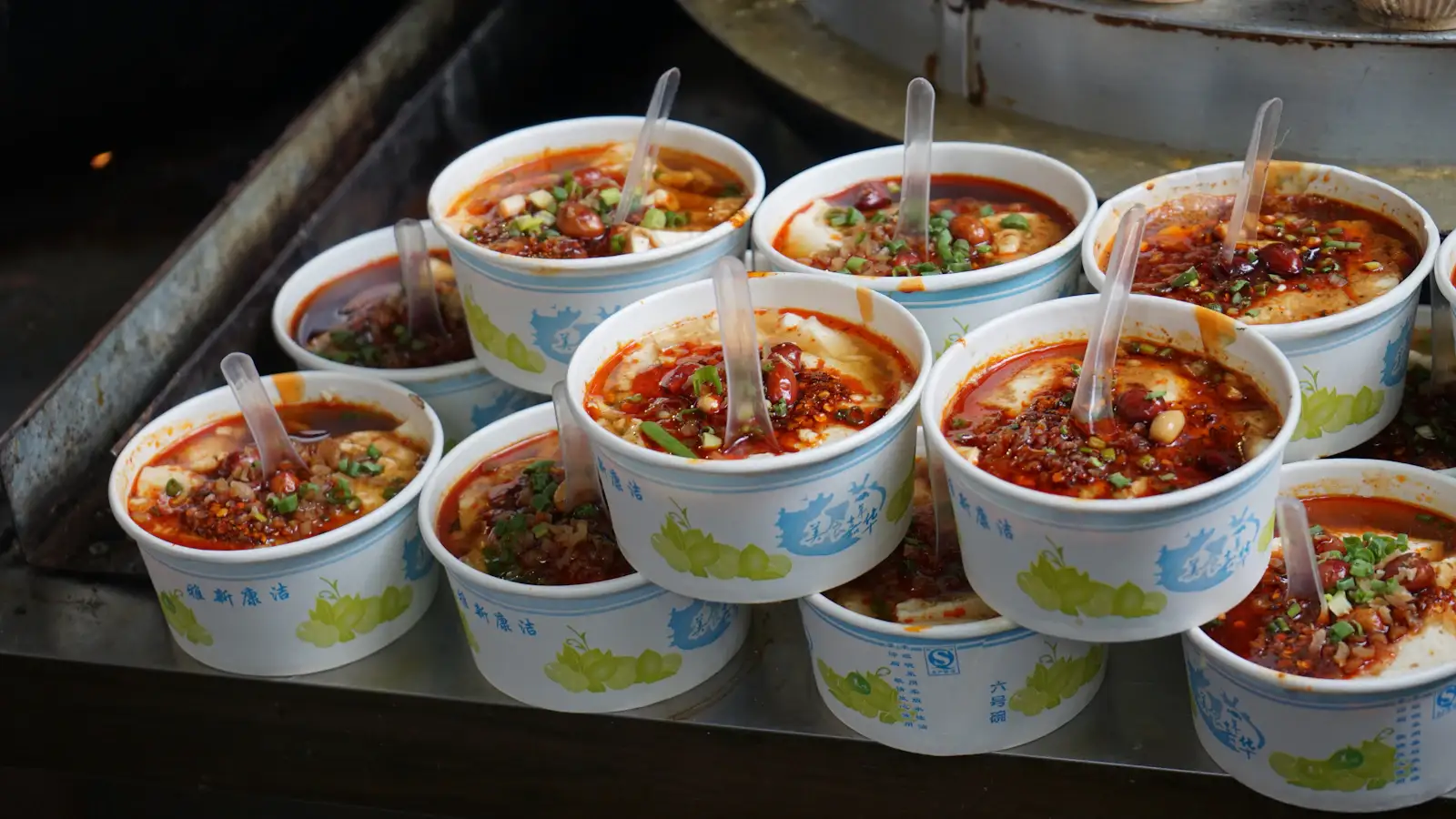
Chengdu eats late, eats loud, and eats spicy. Walk down a lane like Kuanzhai Alley or the streets around Yulin at dusk and you’ll hit a wall of smells: toasted peppercorn, frying dough, simmering broth, chili oil hitting a hot wok. For a lot of visitors this is the whole reason to come to Sichuan. It can also be intimidating if you don’t read Chinese, don’t know the spice codes, and have heard secondhand horror stories about street food and upset stomachs.
The good news: eating well and safely here is mostly about knowing what to look for. Chengdu’s street food scene is competitive, which works in your favor. Popular stalls sell out and restock constantly, so ingredients rarely sit around. The bigger risks for foreign travelers are usually not dramatic food poisoning but two milder problems: underestimating the spice, and drinking the wrong water.
This guide breaks down how to judge a stall, how the spice system actually works, and which dishes are worth your appetite.
The two things that trip up newcomers
Spice. Sichuan heat has two dimensions. There’s la (杈?, the chili burn you probably expect, and ma (楹?, the strange tingling numbness from Sichuan peppercorn that makes your lips buzz. Together they’re called mala. A dish can be low on chili but still very ma, so “not too spicy” doesn’t always mean what you think.
Water and ice. Don’t drink tap water, and be a little cautious with ice and pre-cut fruit rinsed in tap water at informal stalls. Bottled water is cheap and everywhere. This single habit prevents most traveler stomach trouble.
Options Compared
Not all street food is equal in terms of risk and reward. Here’s how the main formats stack up.
Freshly cooked to order (lowest risk)
Stalls that fry, boil, or grill in front of you are your safest bet. Heat kills most of what could make you sick, and you can see exactly how fresh things are.
- Guo kui (閿呯洈) —a crisp stuffed flatbread, griddled and often filled with spiced beef or pork. Cooked hot, handed to you in a paper sleeve. Very low risk.
- Chuan chuan / bochuan (串串) —skewers you pick yourself, cooked in bubbling broth. Because everything is boiled thoroughly, this is safer than it looks.
- Jian bing and egg pancakes —cooked on a hot griddle to order.
Simmered and held hot (moderate, choose busy stalls)
- Dan dan noodles, sweet water noodles, wontons in chili oil —assembled fast from components. At a high-turnover shop this is fine; at a dead-quiet stall the sauces and toppings may have sat too long.
- Braised snacks (鍗ゅ懗) like tea eggs, braised tofu, and marinated meats —generally safe since they sit in hot or acidic braise, but pick vendors with visible customer flow.
Cold and pre-prepared (highest caution)
- Liang fen / liang mian (凉粉/凉面) —cold jelly noodles and cold wheat noodles in chili dressing. Delicious, but they’re served at room temperature and dressed with raw aromatics. Only from clean, busy stalls.
- Cut fruit and raw-vegetable sides —the water used to rinse them matters. Skip if the setup looks grimy.
A quick hygiene checklist
Before you order, glance for these:
- A crowd, especially locals. Turnover is the best safety signal there is.
- Cooking heat you can see. Flames, boiling broth, a hot griddle.
- Clean hands and separate cash handling. Ideally the person taking payment isn’t the one plating food; if it’s a one-person stall, mobile payment sidesteps the issue.
- Ingredients kept covered or on ice, not baking in the sun.
- Your own gut feeling about the general tidiness. If it smells off or looks neglected, walk on. There’s another stall 20 meters away.
Our Recommendation
If you want a plan rather than a list, here’s how I’d approach a first eating session in Chengdu.
Go hungry but pace yourself. Street food here is about grazing across many small things, not one big plate. Order one item, taste it, then decide.
Start mild and calibrate. Your first dish should be something that reveals the flavor without wrecking you. Good openers:
- Tian shui mian (甜水面), sweet water noodles —thick chewy noodles in a sweet, garlicky, mildly spicy sauce. A gentle intro to the la/ma combo.
- Guo kui —bread is a safe harbor, and the crisp texture is genuinely great.
- Zhong shui jiao (钟水饺) —dumplings in a sweet-savory chili-oil dressing, more fragrant than fiery.
Then push into the classics once you know your tolerance:
- Dan dan noodles (鎷呮媴闈? —the benchmark dish. Small portions, sesame-and-chili sauce, preserved vegetable, minced pork. Order a small bowl.
- Chuan chuan xiang (串串香) —the skewer experience, ideal for a group. You control quantity, everything is boiled, and you can choose a non-spicy broth (清汤) alongside the red mala one.
- Long chao shou (龙抄手) —plump wontons, available in spicy or clear-broth versions.
For the brave: mao xue wang (a bubbling mala hotpot-style dish), fei chang / offal skewers, and full-strength mala hotpot. These are the real deep end.
Spice ordering phrases that actually work
When you order, use these:
- 微辣 (wei la) —mild
- 中辣 (zhong la) —medium
- 特辣 (te la) —extra spicy
- 不要辣 (bu yao la) —no chili, please
- 少麻 (shao ma) —less numbing peppercorn
A realistic warning: many stalls make dishes to a fixed recipe and can’t truly dial the heat down. “Mild” in Chengdu can still be hotter than “spicy” back home. Order small the first time.
What to drink
Skip cold water to fight the burn; it doesn’t help much. Locals reach for sweet soy milk (璞嗘祮), cold suan mei tang (plum drink), or plain rice to cut the heat. Dairy and starch calm chili better than water does.
If a sit-down meal turns into a hosted dinner, you may also see small glasses of baijiu used for toasts rather than casual sipping. You do not need to become an expert for a Chengdu food crawl, but Baijiu365’s guide to how to drink baijiu politely is useful background before a banquet-style meal.
Setup Walkthrough
A little prep makes the whole thing smoother. Do these before you head out for the evening.
- Set up mobile payment. Alipay and WeChat Pay now let foreign travelers link an international card. Set this up before your trip and top up or verify it works. Many vendors carry no change and quietly prefer QR codes.
- Save a translation app offline. Download offline Chinese in your translation app and learn the five spice phrases above. Pointing at a menu photo plus “wei la” gets you a long way.
- Carry small backups. A pack of tissues (many stalls don’t provide napkins), hand sanitizer or wipes, and basic anti-diarrheal or stomach medication. You probably won’t need the last one, but it turns a bad night into a minor one.
- Buy bottled water first. Grab a couple of bottles from any convenience store so you’re never tempted by tap water or sketchy ice.
- Pick the right area. For a dense, low-effort first outing, head to the lanes around Kuanzhai Xiangzi, the Jinli food street, or the more local Yulin neighborhood in the evening. Snack markets like these put many vendors side by side, so comparing crowds and hygiene is easy.
- Eat where locals eat, and eat early-ish. Peak local dinner runs roughly 6 to 9 pm, when turnover is highest and food is freshest. Very late-night stalls can be great too, just apply the checklist more strictly.
- Go slow across a couple of hours. Space out spicy dishes so your stomach keeps up. Two or three items, a break and a drink, then a couple more.
Key Takeaways
Chengdu street food rewards a little knowledge and a light touch. Choose busy stalls with visible cooking and high turnover, stick to bottled water, and treat cold or pre-cut items with more caution than freshly fried ones. Learn the difference between la (chili burn) and ma (numbing peppercorn), order small your first time, and remember that “mild” here is relative. Start with gentler dishes like sweet water noodles and guo kui before working up to dan dan noodles, chuan chuan skewers, and full mala. Set up mobile payment and a translation app in advance, keep soy milk or rice handy to tame the heat, and you’ll get the best of one of the world’s great eating cities with very little risk.
Loading comments...